
PATA India Tourism PowerHouse 2026 charts data-driven growth roadmap for India
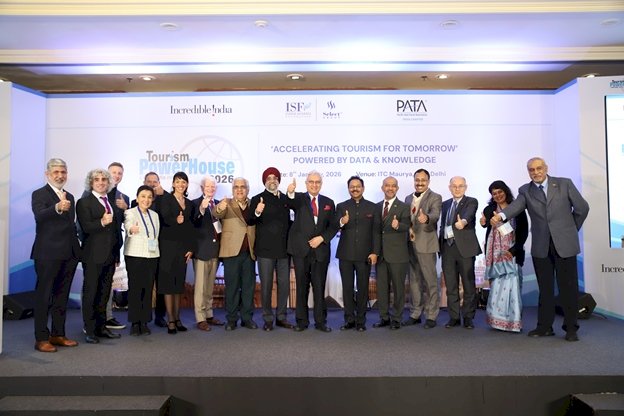
The fourth edition of the PATA India Tourism PowerHouse held on 8th & 9th January 2026 at New Delhi, and delivered under the aegis of Ministry of Tourism & Inder Sharma Foundation, brought together senior government leaders, global experts and industry stakeholders in New Delhi to shape a forward-looking roadmap for India’s tourism growth. Hosted by the PATA India Chapter at Hotel ITC Maurya, the full-day forum was supported by the Ministry of Tourism and the Inder Sharma Foundation, under the theme Accelerating Tourism For Tomorrow Powered by Data and Knowledge.
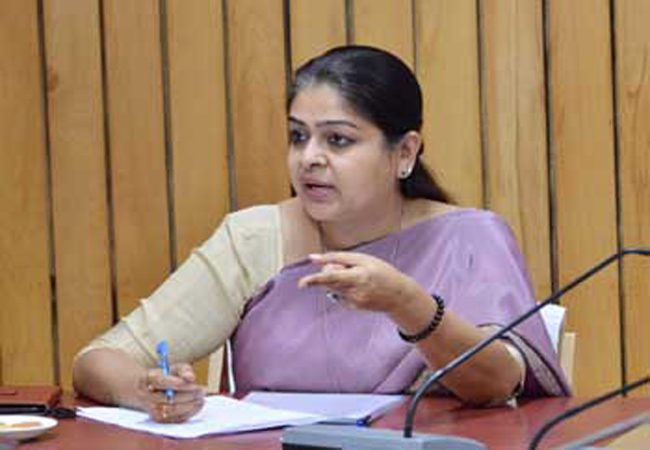
The forum was led by Dr Suman Billa, Additional Secretary and Director General Tourism, Government of India, along with Noor Hamid, CEO of Pacific Asia Travel Association, and the PATA India Executive Committee.
Welcoming delegates, Vikram Madhok, Vice Chairman PATA India, highlighted India’s strong inbound recovery, noting that international arrivals have largely returned to prepandemic levels, driven by markets such as the US, UK, Australia and Asia Pacific. He shared that India recorded over 20 million international arrivals in 2024, generating USD 35 billion in foreign exchange and supporting 84 million jobs, while stressing that aviation expansion and new airports remain critical to sustaining momentum.
Addressing the gathering, Arjun Sharma of the Inder Sharma Foundation said that if tourism has the power to connect humanity, institutions must help guide that power with wisdom and responsibility.
In his keynote address, Dr Suman Billa Additional Secretary and DG Tourism, underlined the need for government and industry to work in lockstep to position tourism as India’s national growth multiplier. He stressed the importance of tapping the digital traveller, institutionalising Indian cities as global MICE hubs and shifting focus from volume to value. “India’s tourism challenge is not demand but conversion,” he said, adding that despite massive infrastructure growth, tourism contributes just 5.5 per cent to GDP. He called for stronger destination management, AI adoption and sustainability-led growth.
Speaking on India’s global positioning, PATA CEO Noor Hamid said India is not just a destination but a collection of layered and emotional experiences. He urged the industry to move beyond the traditional Incredible India narrative towards sustainable, community-led tourism that creates long-term value.
Global market insights were shared by Prof. Haiyan Song, Chair of the School of Hotel and Tourism Management at Hong Kong Polytechnic University, who said India’s outbound market will remain stable and resilient, with Thailand, the US and Singapore continuing to lead demand. He noted that India’s outbound growth follows a stage-like trajectory driven by first-time travellers, unlike the mature and frequency-led growth seen in Southeast Asia. He also highlighted Sri Lanka’s rise as a fast-growing destination due to proximity, pricing and targeted outreach.
On the power of intelligence-led decision making, Olivier Ponti, Vice President Intelligence and Marketing at ForwardKeys part of Amadeus, stressed that India’s next tourism leap must be driven by real-time data rather than instinct. He pointed out that limited direct connectivity from Europe and Oceania is constraining long-haul inbound growth and suggested twindestination itineraries and hub partnerships as practical solutions.
Calling for a rethink on growth metrics, Alan Merschen, Founder of MMGY and The Sigmund Project, said tourism growth does not need more seats but one extra day per visitor, which delivers higher returns with lower environmental impact.
During a fireside chat, Puneet Chhatwal, MD and CEO of Indian Hotels Company and Chairman of FAITH, described tourism as India’s fastest soft-power tool. He said no other sector builds the same emotional connect globally as tourism and hospitality.
On sustainability, Ludwig Rieder, Co Founder and Chairman of Asia Pacific Projects, stressed that ESG is no longer optional. Access to markets, capital and partnerships, he said, will increasingly depend on transparent governance, sustainability and local talent development.
The session on MICE highlighted India’s capability to host large-scale global events, with S Harikishore, Chairman of the India Convention Promotion Bureau & Joint Secretary Ministry of Tourism, pointing to the G20 as proof of capacity and calling for sustained global promotion and structured bidding supported by strong public-private collaboration.
On crisis management, Anita Mendiratta, Special Advisor to the Secretary General of UN Tourism, said crises impact not just tourism operations but a nation’s identity. She emphasised that clarity, empathy, calm communication and a single credible voice are essential for effective recovery.
Adding a global perspective on seasonality, Narzalina Lim, Former Tourism Secretary of the Philippines, spoke on developing India’s year-round appeal through product diversification and strategic promotion.
Looking ahead, Matt Gibson, CEO of UpTHINK, said India is exceptionally well placed for AI-driven travel growth, citing high consumer confidence and strong digital infrastructure.
Concluding the PowerHouse, Dr Suman Billa summed up the day’s deliberations by calling for smarter data use, sustainability-first thinking, AI adoption and deeper partnerships to shape India’s tourism future. The success of the fourth edition was underscored by Dr Suman Billa, who noted that the Tourism PowerHouse has evolved into a platform of real strategic value for India’s tourism ecosystem. Reflecting on the depth of dialogue and quality of participation, he said the forum should now be institutionalised as an annual engagement, bringing government, global experts and industry leaders together every year to review progress, recalibrate priorities and collectively steer India’s tourism growth agenda.
The fourth PATA India Tourism PowerHouse concluded with a clear message. Big ideas, honest insights and decisive action will define how India accelerates its journey towards becoming a globally competitive, high-value tourism destination.



















/hospibuz/media/media_files/2026/04/02/sing-malay-phil-india-cam-kv-sale-deluxe-15-4-4-2026-04-02-13-39-48.jpg)